


Export iPhone and iPad calendars to iCal, Excel or CSV
Your iPhone or iPad stores calendars from iCloud, Google, and other accounts, but the Calendar app offers no direct way to save them as files on a computer. iMazing exports your calendars to your Mac or PC, so you can move the events to another device or view your schedule on a computer where you are not signed in to those accounts. If you've lost your iPhone, you can also recover events from any iOS backup, regardless of the app that created it.
You can export individual events, a single calendar, or all your calendars. ICS files open in most calendar apps, and Excel or CSV (comma-separated values) files open in any spreadsheet application.
Here's how to export iPhone and iPad calendars to iCal, Excel or CSV
Select Calendar
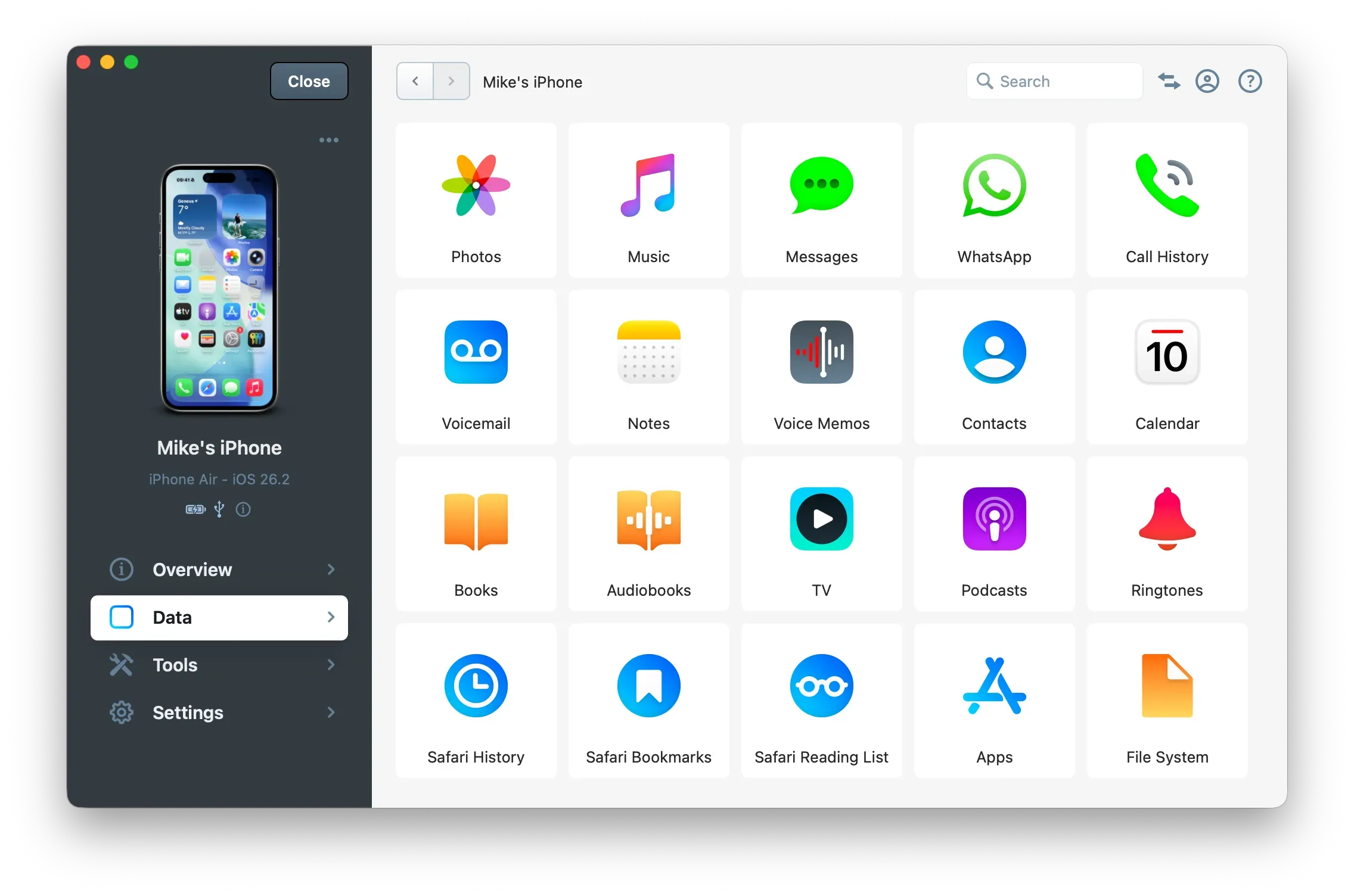
In the left sidebar, click Data to open the dataset list, then click Calendar.
Choose how to load your data
iMazing needs to create a backup to extract data from your device. You can choose whether you only need access to your calendars, or whether you want to create a full, restorable backup of the device. A partial backup uses much less storage, but both options take about the same amount of time because all files are streamed from your device to your computer during the process. iMazing cannot control which files are streamed.
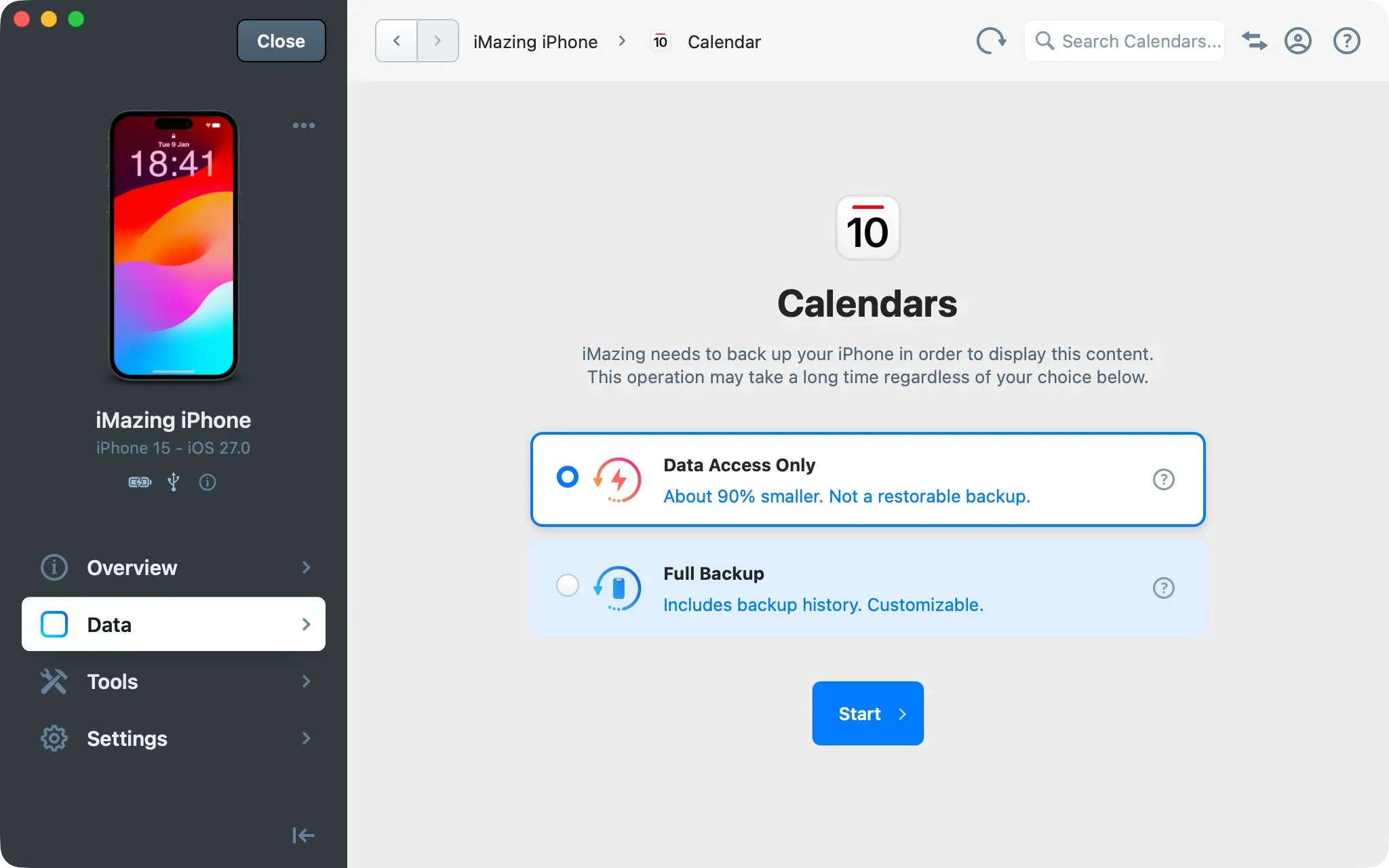
Click Start to launch the operation. iMazing prompts you to enter the passcode on the device.
Important: The first time you back up a device with iMazing, the process may take 30 minutes or more, depending on how much data is stored on the device. USB speed (whether your device supports USB 3.1 or 2.0) and the backup location (for example, a NAS or external drive) can also affect the time it takes. Please be patient. Learn more about data access and full backup options.
For more details on backup performance, see: Understanding & fixing slow iPhone or iPad backups
If a backup of the device already exists, iMazing shows the following prompt instead. Choose whether to open the existing backup or run a subsequent backup to refresh the contents.
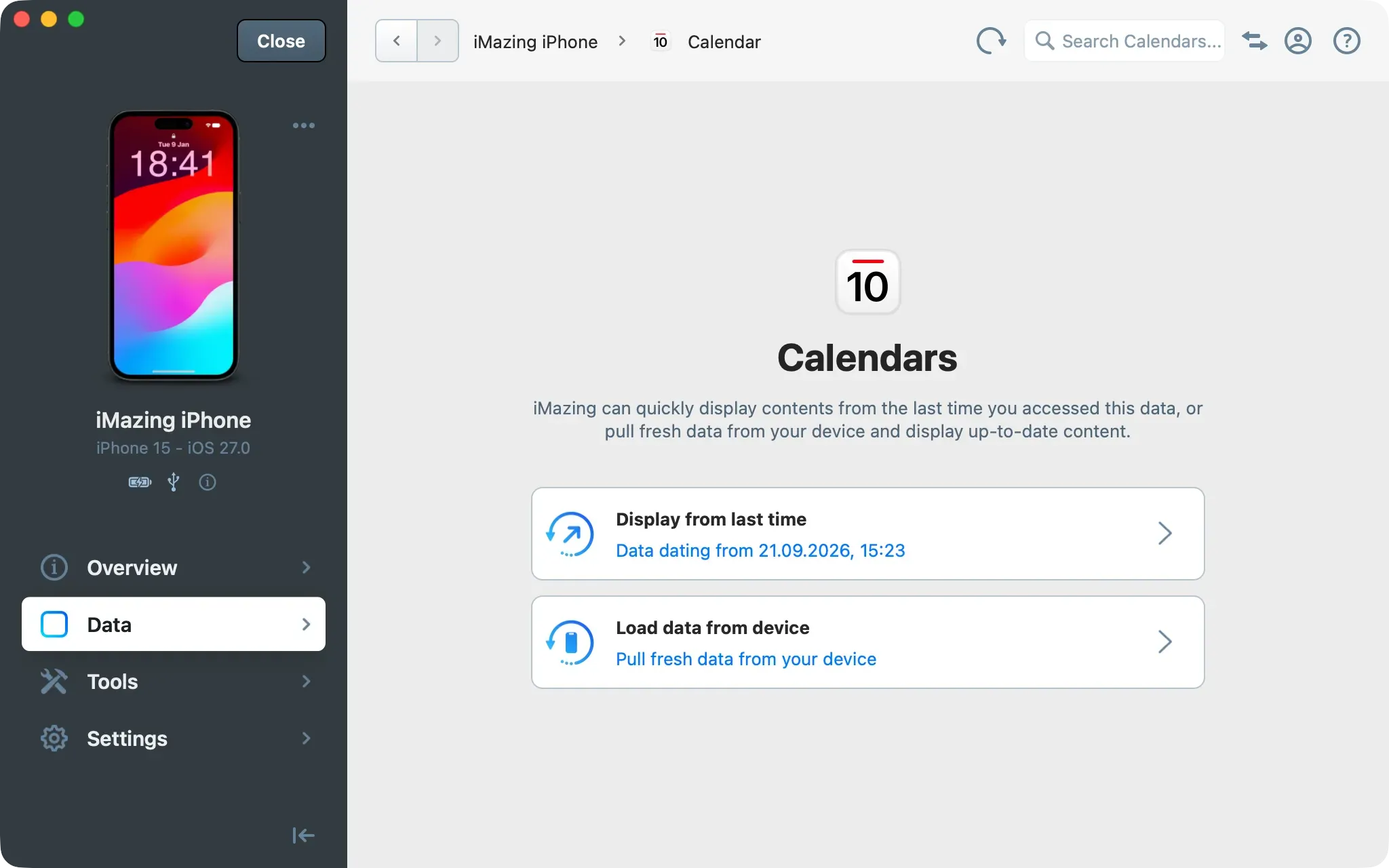
Tip: Subsequent backups are incremental and much faster. You can request a newer backup at any time with the Refresh button (the circular arrow) in the top toolbar.
Browse your calendars
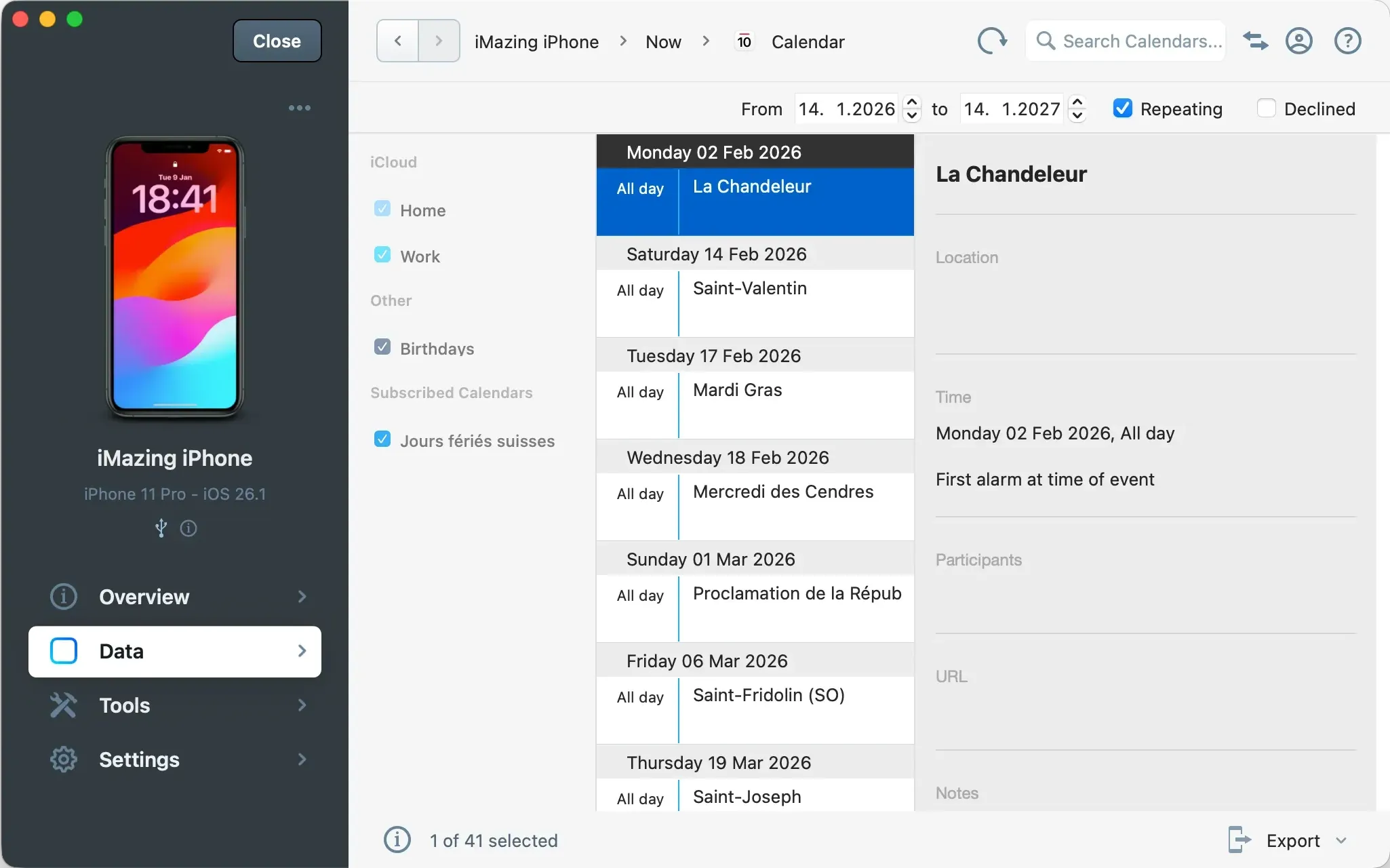
Once iMazing finishes loading the data, it displays your calendars in the main window.
If your device has calendars from multiple accounts, such as iCloud or Google, each account appears as a separate heading in the calendar list on the left.
Browse an existing backup
You can browse your calendars without connecting your iPhone, as long as iMazing already holds a backup of the device. iMazing can also open backups made with iTunes, Finder, or Apple Devices once you add them to iMazing.
- On the Home Screen, open the Backups section to see every backup iMazing manages.
- Select the backup you want to open. iMazing opens it so you can browse its content, no device connection is required.
- In the left sidebar, click Data, then click Calendar.
Note: When browsing from a backup, iMazing reads only the stored backup, so no new backup is created. For more on browsing and extracting data, see the Manage your backups with iMazing guide.
Browse from a previous snapshot
Each time iMazing backs up your device, it keeps a timestamped snapshot, so you can open your calendars as they existed at an earlier date. This works like macOS Time Machine, applied to your iOS or iPadOS backups.
By default, iMazing shows the current state of your device or the latest backup. To reach an earlier state:
- Select your device or a backup from the Home Screen.
- In the upper toolbar, click the Now button to open the Snapshot List.
- Select an earlier snapshot. iMazing reloads the Calendar view with the events contained in that snapshot.
A gray checkmark marks the state you are currently viewing. Select Now again to return to the current state.
Tip: For details on snapshot labels and management, see the Backup Snapshot List in iMazing guide.
Filter your calendars
Type in the Search Calendars field, at the top right of the window, to search event titles, locations, and notes.
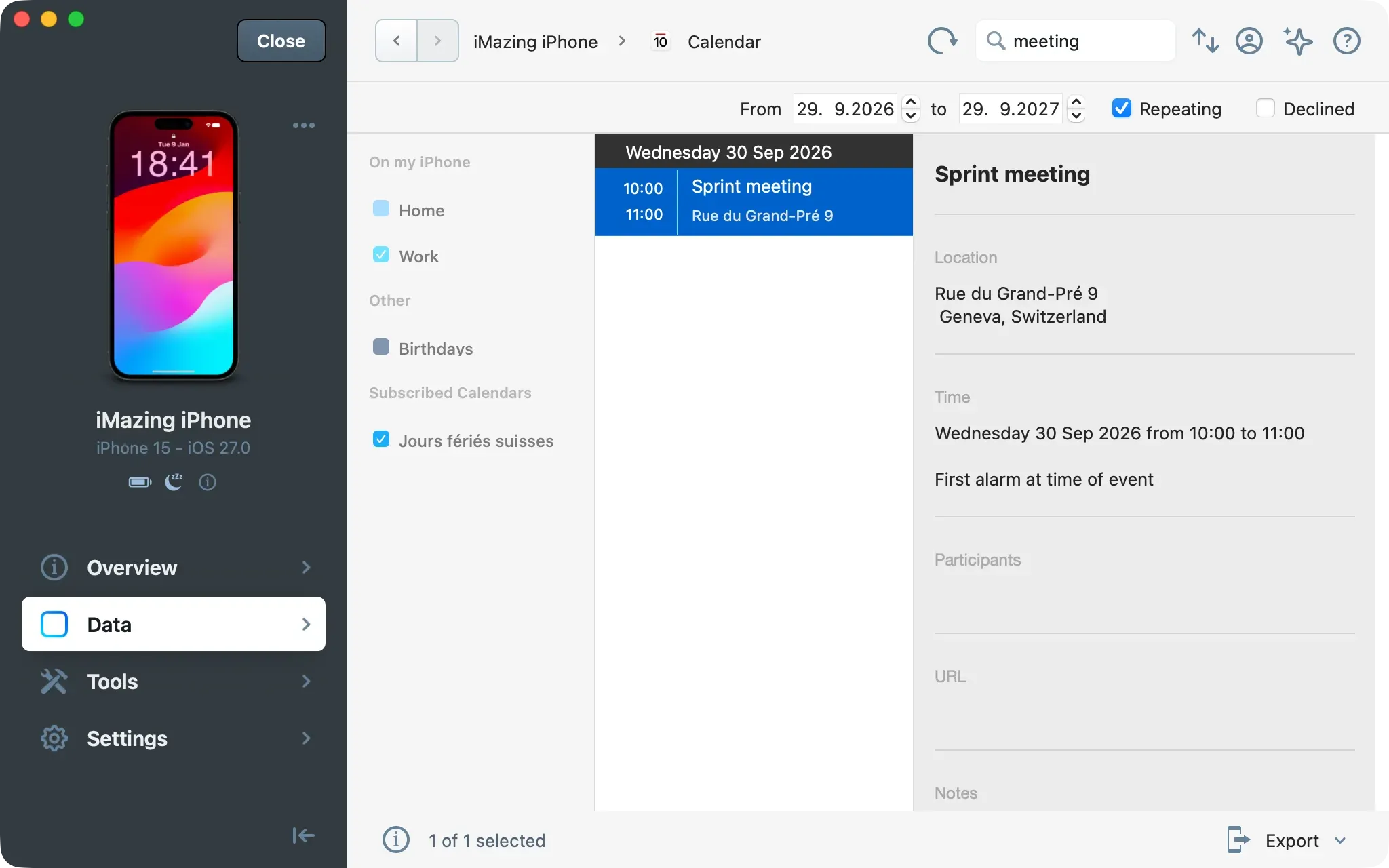
By default, all calendars are displayed together. Adjust the filters before exporting to control which events are included:
- In the calendar list, uncheck any calendar you want to exclude. iMazing updates the event list to reflect your selection.
- Click the From and To date boxes in the top toolbar to set a date range. By default, From is set to today and To is set to one year from today.
- Repeating is checked by default. Uncheck it to hide recurring events.
- Declined is unchecked by default. Check it to include events you were invited to but declined.
Export your calendars
Export events to ICS
Select one or more events from the list, click Export in the bottom toolbar, then choose iCal in the menu. In the dialog, choose whether to export your current selection or all items, then select a destination.
The resulting .ics file can be opened by most calendar apps on macOS and Windows. Double-click it to import its events.
Tip: Hold Shift and click the first and last item to select a range. Hold Ctrl (Windows) or Command (macOS) and click to add individual items to your selection. Use Ctrl+A (Windows) or Command+A (macOS) to select all.
Tip: Drag your selection directly to a folder on your desktop to export selected events as an
.icsfile without going through the dialog.
Export events to Excel or CSV
Select one or more events, click Export in the bottom toolbar, then choose Excel or CSV in the menu. In the dialog, choose whether to export your current selection or all items, then select a destination.
The file contains one row per event, with columns for the event name, date and time, location, alarms, repeat frequency, and more. Open it in Microsoft Excel, Apple Numbers, or any compatible spreadsheet application.
Export an entire calendar
Right-click (or Control-click on macOS) a calendar name in the left sidebar, then select Export from the contextual menu. This exports all events in that calendar regardless of your current date range or filters.