


Transfer iPhone voicemail to your Mac or PC computer
Updated on Sep 21, 2026
Reading time ~5 minutes
Voicemail messages on iPhone can contain important conversations you want to keep. However, iOS does not provide any way to export individual recordings or save them as files on your computer.
Because these recordings are not directly accessible on the device partition, iMazing uses the iOS backup mechanism to read your voicemail, then exports each recording as a standard audio file to your Mac or PC.
Here's how to transfer iPhone voicemail to your Mac or PC computer.
Before you begin
Select your device
Open the Devices section in the left sidebar to see every device connected and paired to your computer. Click a device to select it.
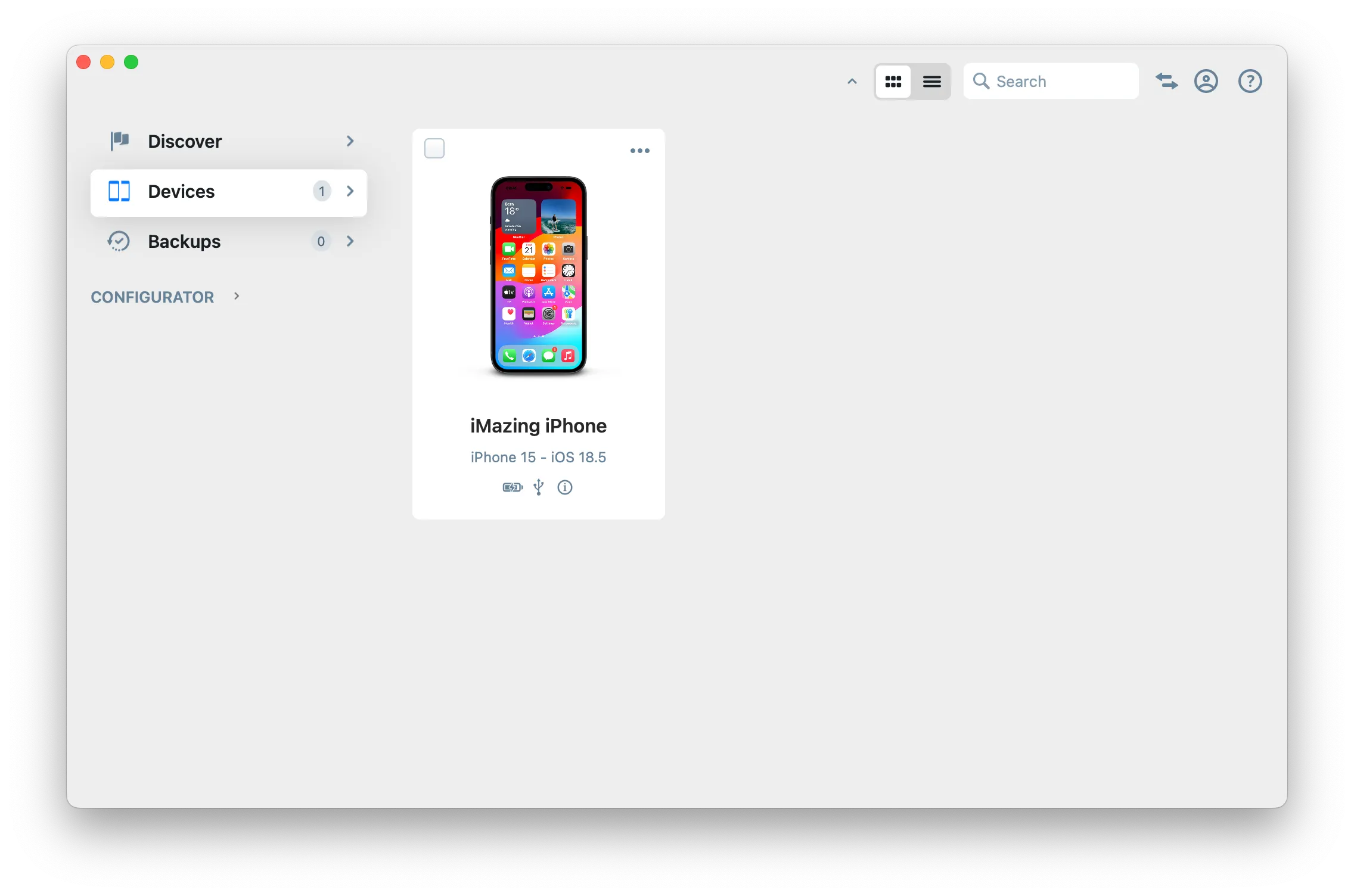
Tip: To learn how devices, datasets, and tools are organized, see the iMazing interface guide.
Select Voicemail
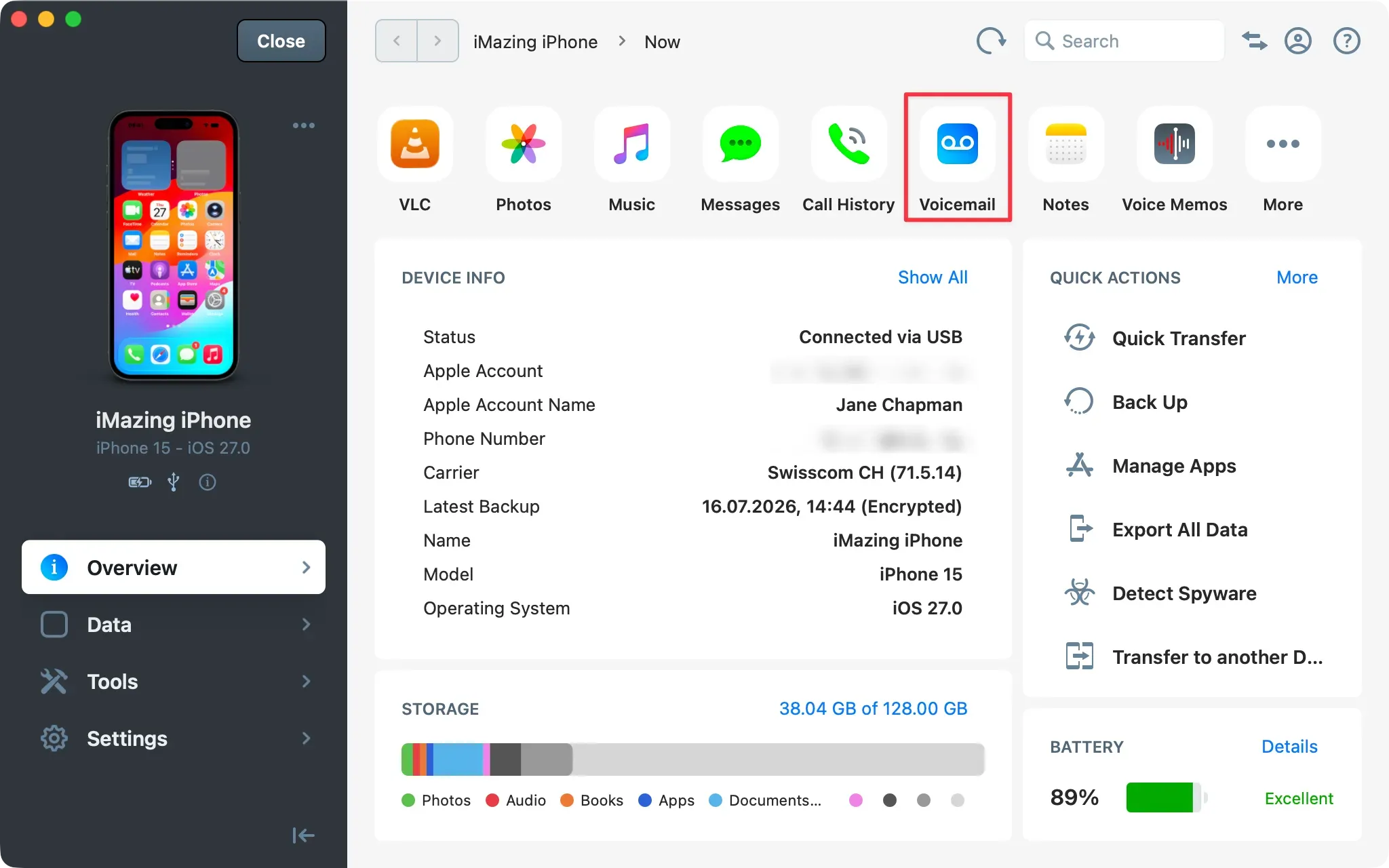
On the device Overview, click Voicemail in the datasets row.
Choose how to load your data
iMazing needs to create a backup to extract data from your device. You can choose whether you only need access to your voicemail, or whether you want to create a full, restorable backup of the device. A partial backup uses much less storage, but both options take about the same amount of time because all files are streamed from your device to your computer during the process. iMazing cannot control which files are streamed.
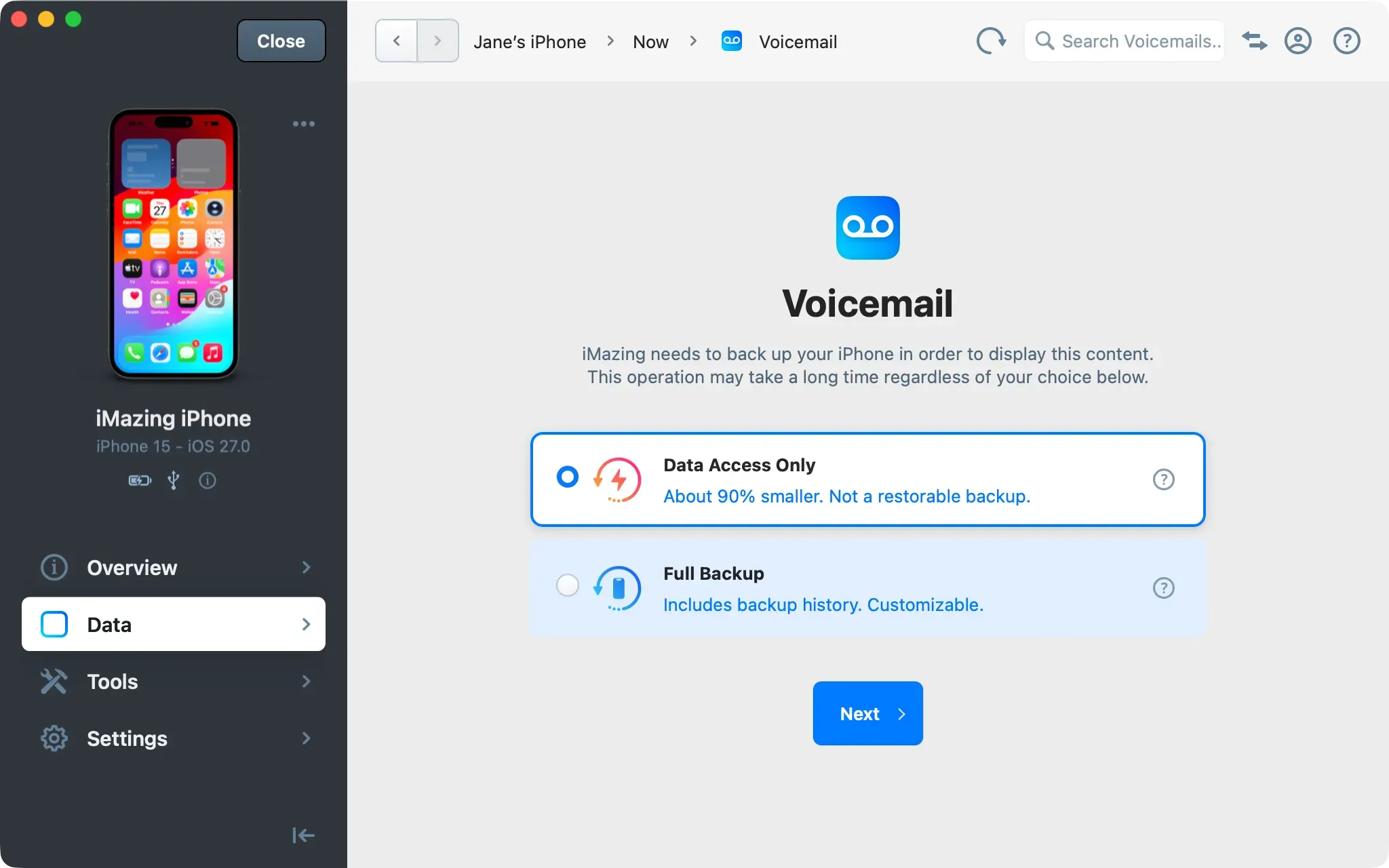
Important: The first time you back up a device with iMazing, the process may take 30 minutes or more, depending on how much data is stored on the device. USB speed (whether your device supports USB 3.1 or 2.0) and the backup location (for example, a NAS or external drive) can also affect the time it takes. Please be patient. Learn more about data access and full backup options.
For more details on backup performance, see: Understanding & fixing slow iPhone or iPad backups
Browse your voicemail
Once iMazing finishes loading the data, it displays the list of voicemail recordings.
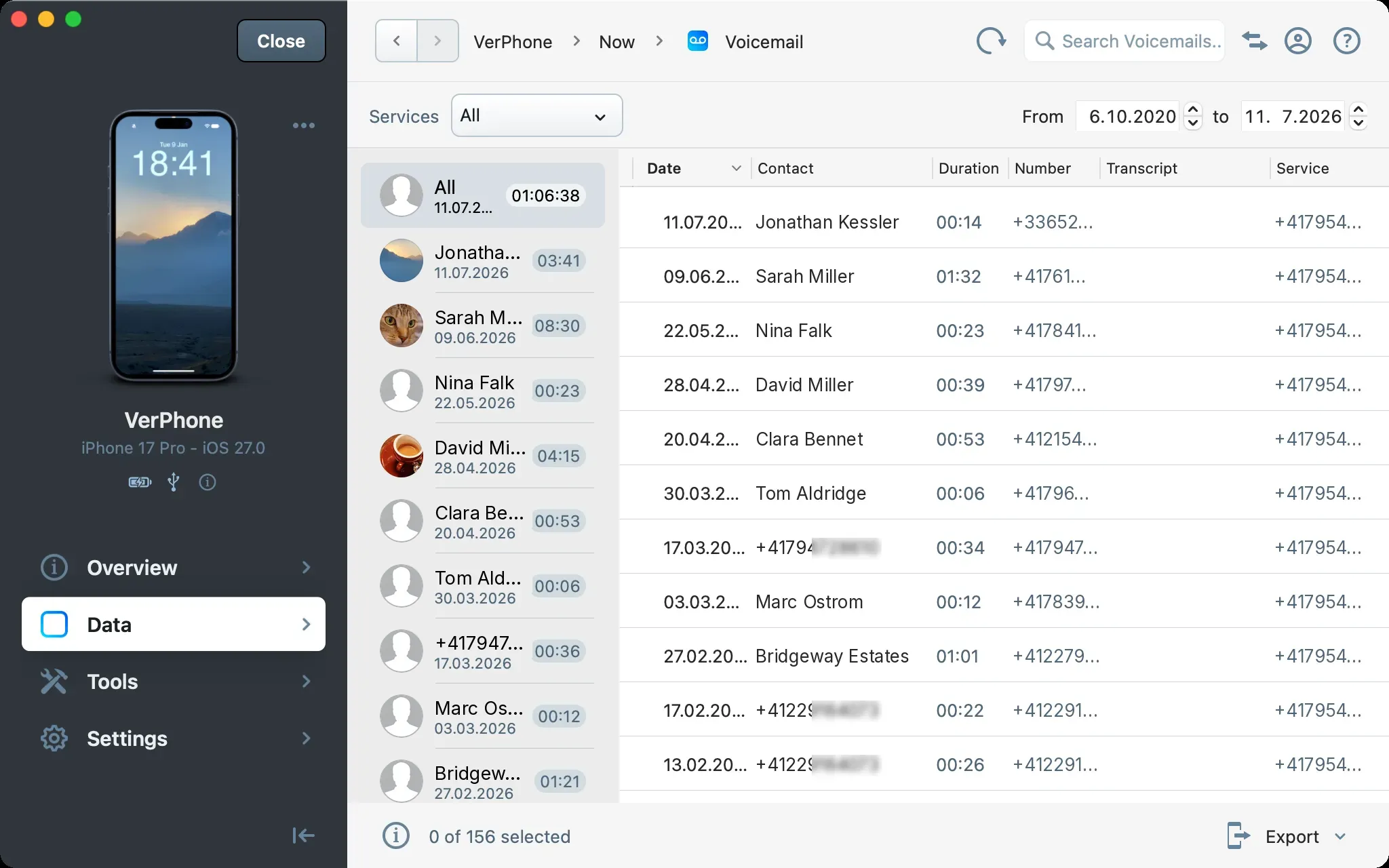
If your iPhone has multiple eSIMs, use the Services section on the left to filter voicemail by carrier. Use the date filter on the right to narrow results by date range.
Note: iMazing accesses voicemail through the iOS backup mechanism, so only recordings that iOS includes in the backup will appear. If some are missing:
- Carrier storage: Some carriers keep voicemail on their own servers instead of on the device. Those recordings are not part of the backup, so iMazing cannot access them. Check with your carrier to confirm.
- Live Voicemail: Messages received while Live Voicemail is enabled (US and Canada only) and transcribed are not included in the backup. Disabling Live Voicemail restores access to new recordings, but not to messages received while it was on. This behavior comes from iOS.
Browse an existing backup
You can browse your voicemail without connecting your iPhone, as long as iMazing already holds a backup of the device. iMazing can also open backups made with iTunes, Finder, or Apple Devices once you add them to iMazing.
- On the Home Screen, open the Backups section to see every backup iMazing manages.
- Select the backup you want to open. iMazing opens it so you can browse its content, no device connection is required.
- On the backup Overview, click Voicemail in the datasets row.
Note: When browsing from a backup, iMazing reads only the stored backup, so no new backup is created. For more on browsing and extracting data, see the Manage your backups with iMazing guide.
Browse from a previous snapshot
Each time iMazing backs up your device, it keeps a timestamped snapshot, so you can open voicemail as it existed at an earlier date. This works like macOS Time Machine, applied to your iOS or iPadOS backups.
By default, iMazing shows the current state of your device or the latest backup. To reach an earlier state:
- Select your device or a backup from the Home Screen.
- In the upper toolbar, click the Now button to open the Snapshot List.
- Select an earlier snapshot. iMazing reloads the Voicemail view with the recordings contained in that snapshot.
A gray checkmark marks the state you are currently viewing. Select Now again to return to the current state.
Tip: For details on snapshot labels and management, see the Backup Snapshot List in iMazing guide.
Export your voicemail
- Select the contact or contacts whose voicemail you want to save. By default, iMazing exports every message from the selected contacts. To export only specific messages, select them individually.
- In the bottom toolbar, click Export.
- In the save dialog, choose the destination, then confirm.
Tip: Hold the Command key (macOS) or the Ctrl key (Windows), or the Shift key, to select multiple contacts or messages. Double-click a voicemail to preview it before exporting.
Voicemail transcripts
The Voicemail view includes a Transcript column showing the transcriptions produced by iOS. A transcript is available only when the caller's voice is clear and in the same language as the iPhone. Availability also depends on your carrier.
Tip: Long transcripts are often truncated in the Transcript column, but they export in full when you use the Export to Excel or CSV option.
What to keep in mind
- Visual Voicemail is an optional feature that lets you view voicemail directly on your device, without dialing a mailbox. Not all carriers support it. If your voicemail does not appear on your iPhone, check this Apple Support article.
- Voicemail audio files are in
.amrformat. On Windows, you need Apple's QuickTime or VLC to play.amrfiles.