Extract files and data from an encrypted iPhone backup
An iPhone backup is more than a safety net: with the right tool, it is a browsable copy of your data. iMazing reads any iOS backup, no matter which app you used to back up your device. You can access system data such as Messages, Photos, and Call History, along with third-party app data, and browse the file system, including files that are not exposed anywhere else. Accessing data from a lost, damaged, or replaced iPhone is not a problem if you have a backup of it.
An encrypted backup stores data that an unencrypted backup leaves out, such as passwords, Health data, and Wi-Fi settings. iMazing decrypts it locally, and nothing leaves your computer.
Tip: To always have a recent backup to browse, set up automatic backups. See Automatically Back Up an iPhone or iPad via Wi-Fi.
Here's how to extract files and data from an encrypted iPhone backup.
Before you begin
Locate your backup in iMazing
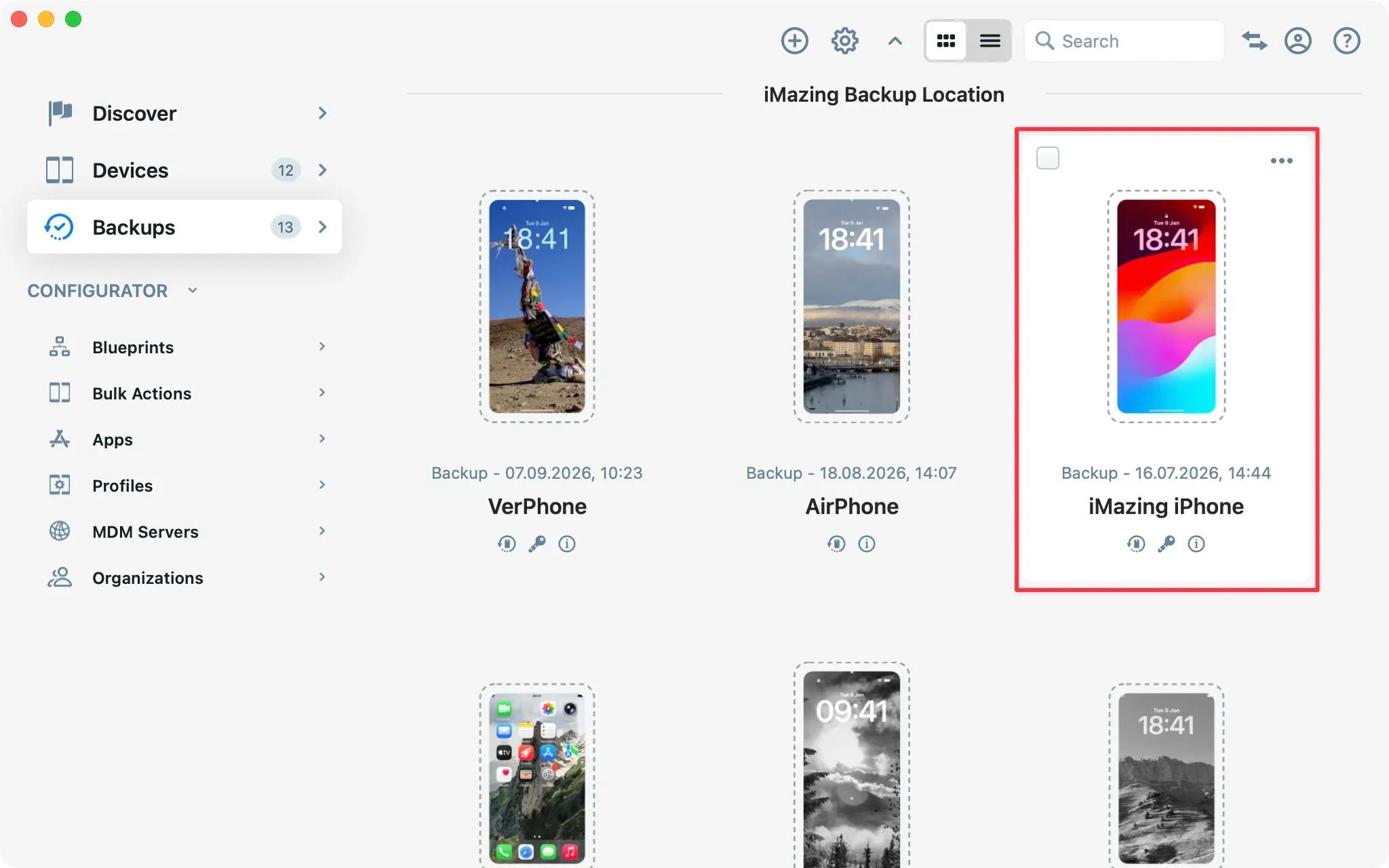
Before you can browse a backup, iMazing needs to list it in the Backups section of the Home Screen. Backups you made with iMazing or iMazing Mini are already there. For other backups, follow the sub-step that matches where your backup came from.
Finder or iTunes backups
Backups you started from Finder (macOS Catalina and later), iTunes (Windows and macOS Mojave or earlier), or the Apple Devices app (Windows) are stored in a fixed folder that iMazing reads directly. On macOS, the system protects that folder, so iMazing needs Full Disk Access before it can list these backups.
macOS
Finder and iTunes backups are stored at /Users/<username>/Library/Application Support/MobileSync/Backup.
Grant Full Disk Access to both iMazing and iMazing Mini:
- In the Backups section of the Home Screen, click the Click here to access all iOS backups link.
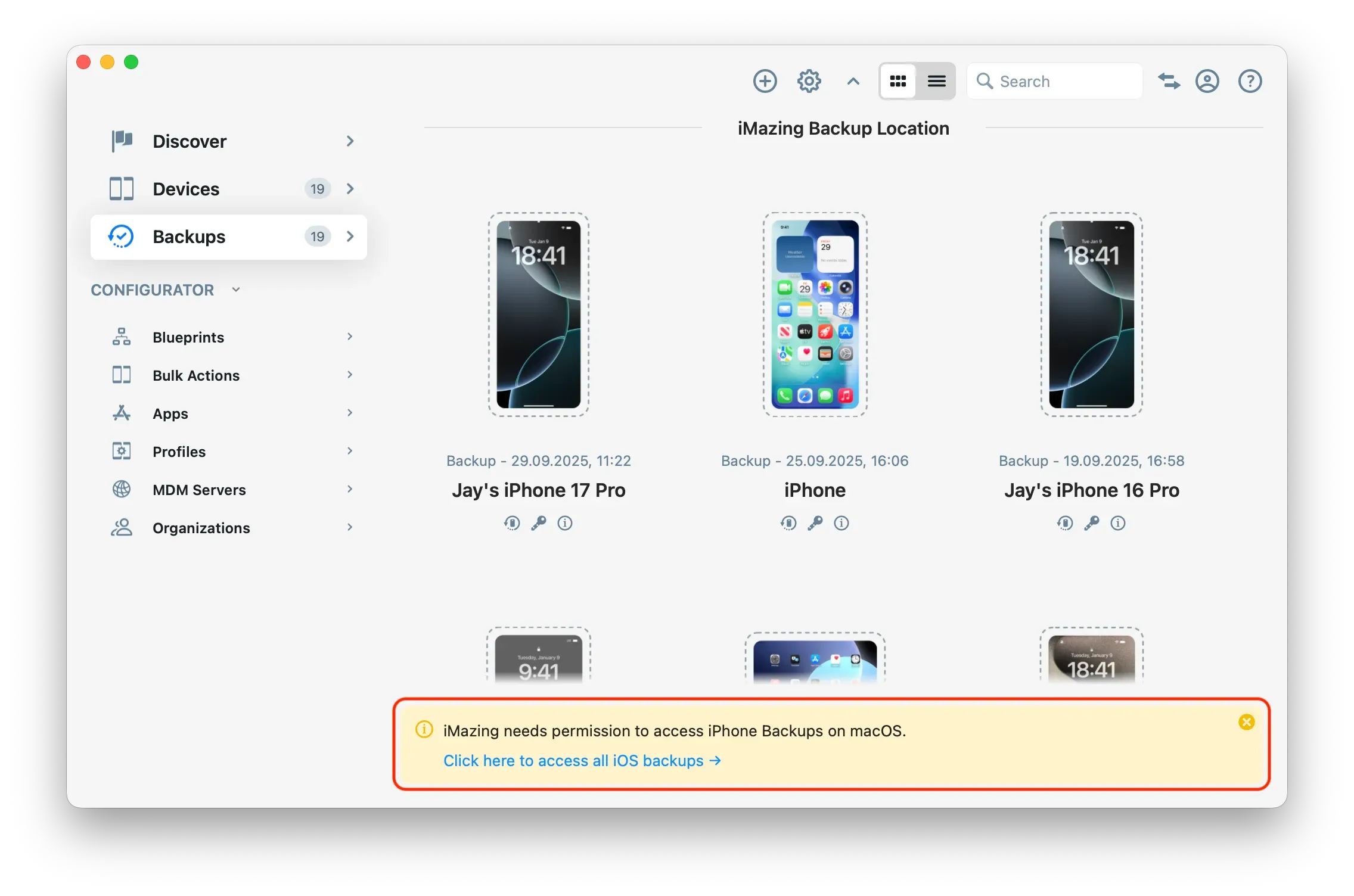
- Click Open System Settings.
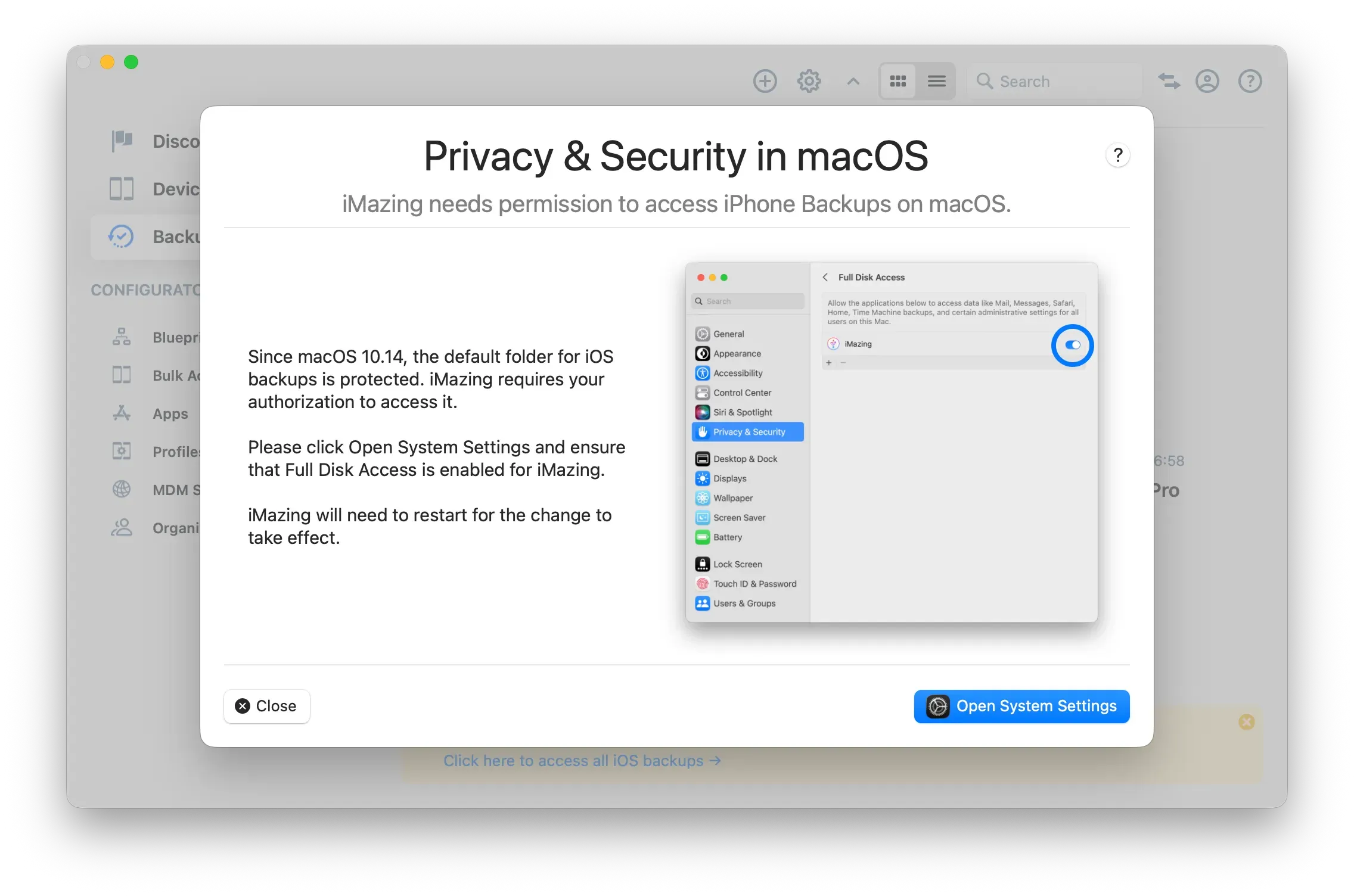
- Enable Full Disk Access for both iMazing and iMazing Mini. If the iMazing app is not listed, click + and select it from your
Applicationsfolder. - Return to iMazing. The Finder and iTunes backups now appear in the Backups section.
Windows
iMazing loads both iTunes and Apple Devices backup locations by default, so these backups appear directly in the Backups section:
- Apple Devices or iTunes from the Microsoft Store:
C:\Users\<username>\Apple\MobileSync\Backup - iTunes installed with the classic installer:
C:\Users\<username>\AppData\Roaming\Apple Computer\MobileSync\Backup
Backups stored in another location
If a backup is stored somewhere iMazing does not track, such as an external drive or a folder copied from another computer, load it manually. If you are not sure where a backup is stored, see Find the location of your iPhone or iPad backup.
- Go to the Backups section on the Home Screen.
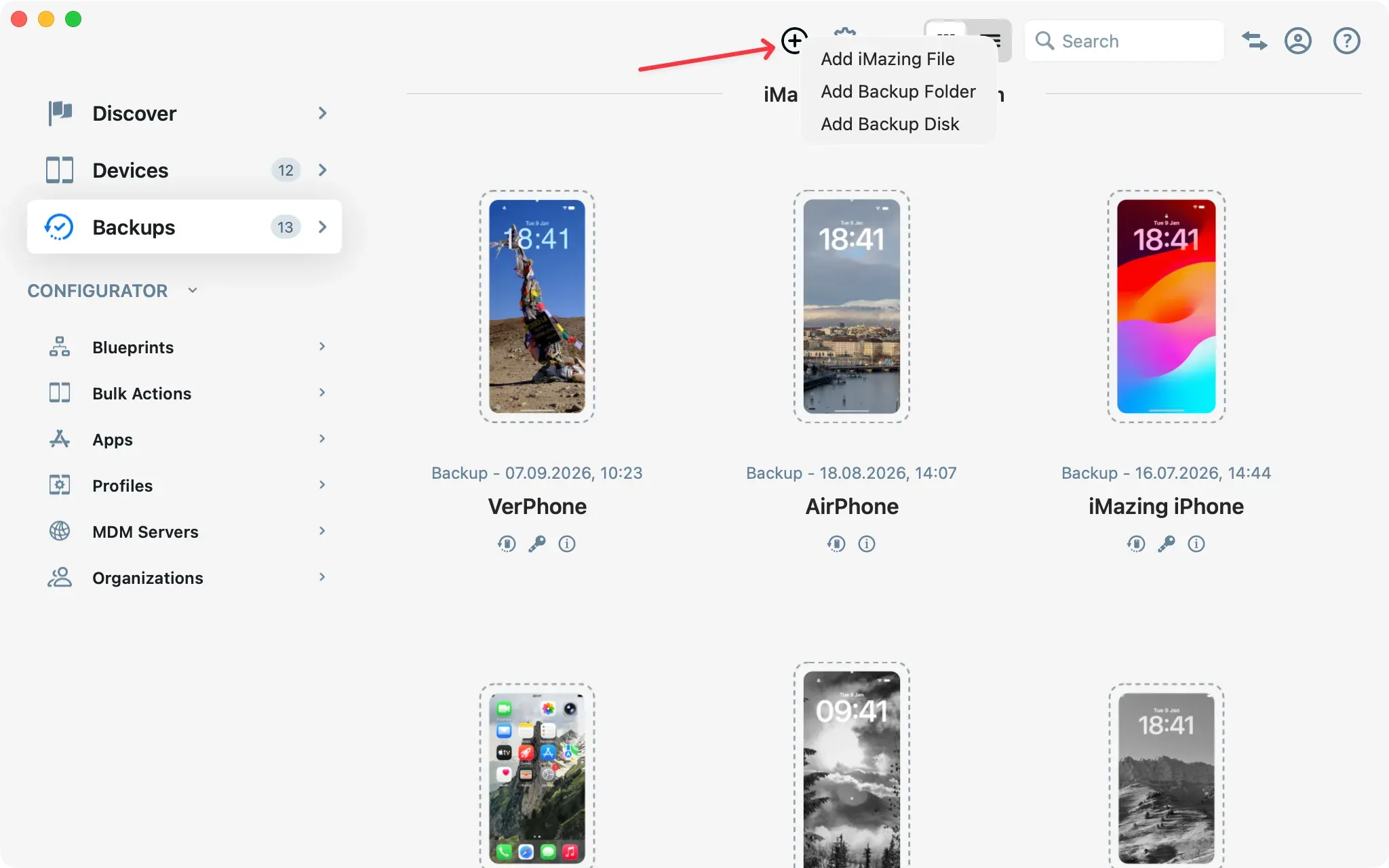
- Click the + button in the upper toolbar.
- Select one of the following options:
- Add iMazing File for
.imazingfiles - Add Backup Folder for a single backup folder
- Add Backup Disk to import multiple backups stored in the same location
- Add iMazing File for
- With Add iMazing File or Add Backup Folder, choose between two options:
- Copy: permanently imports the backup to iMazing's default location
- Open: temporarily opens the backup from its current location for browsing only
Tip: You can also drag a backup folder directly into the Backups section of the Home Screen to import it.
Open the backup
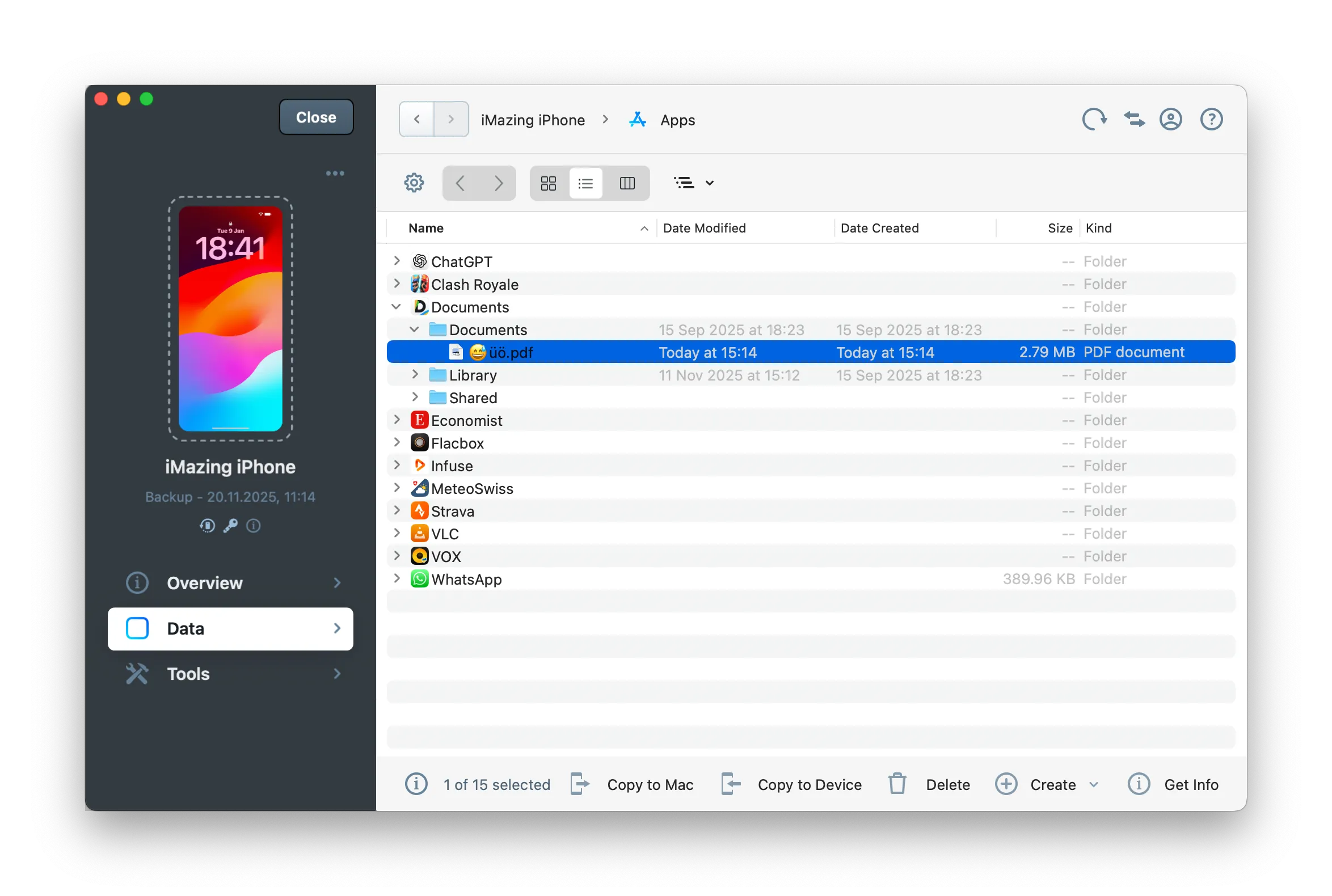
In the Backups section, double-click a backup to open it. iMazing opens the Device Screen in backup mode, with the Overview, Data, and Tools sections.
Browse and export from the Data section
The Overview section gives quick access to the most common datasets. The Data section lists every dataset included in the backup.
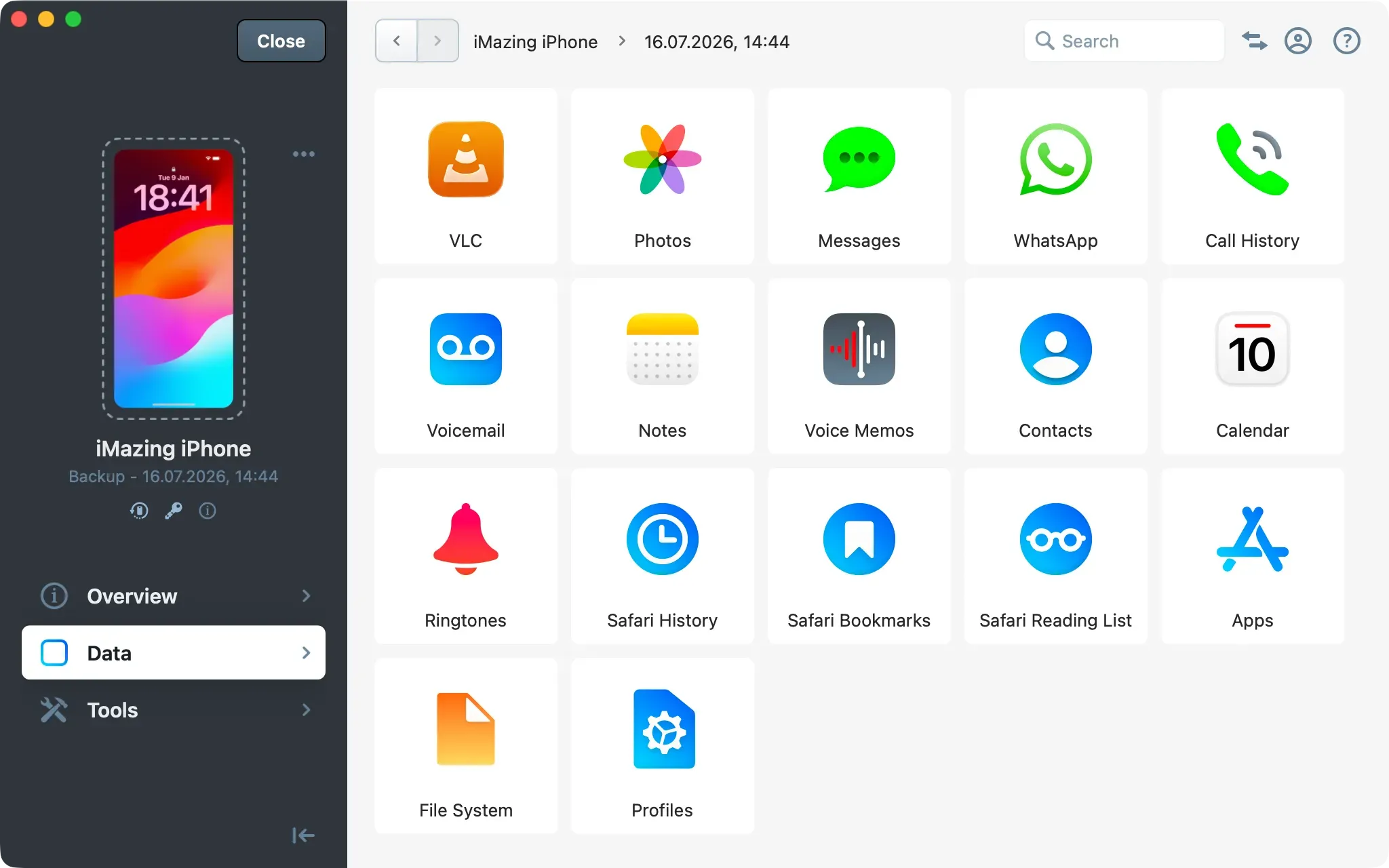
Select a dataset to open it and browse its contents.
Important: iMazing will prompt you for your backup encryption password when loading a dataset. If you backed up your device with iMazing and chose to save the password in your system's keychain (macOS Keychain or Windows Credential Manager), iMazing uses it automatically. If you do not know your password, see Backup: lost or forgotten backup encryption password.
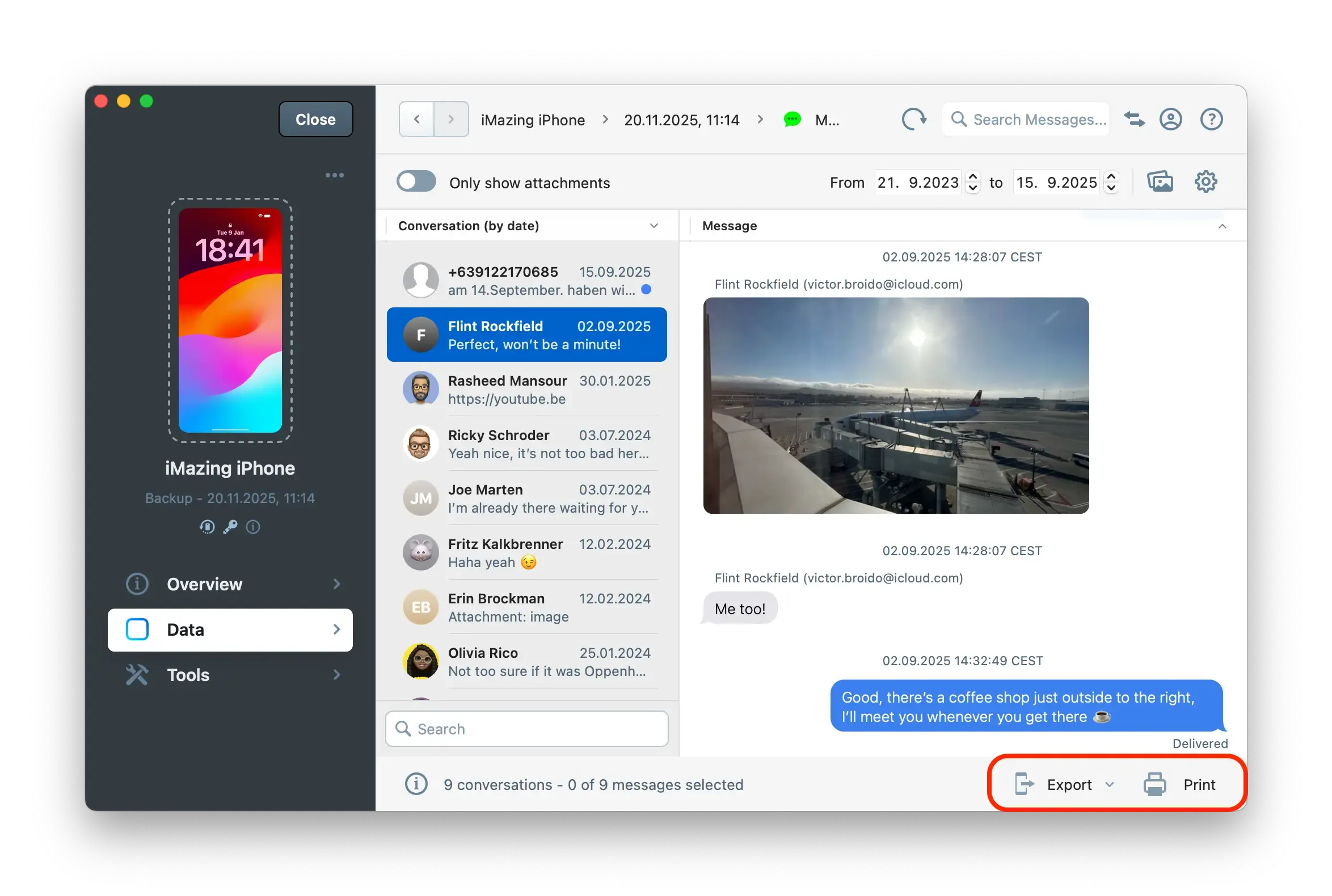
Each dataset opens in its own view, with the export formats that fit its content. For example, Messages exports conversations to PDF, plain text, Excel, or CSV.
For a full walkthrough, see Export iPhone Messages to your computer. WhatsApp conversations export the same way: see Export WhatsApp Chats and Attachments from iPhone.
The following datasets are accessible from a backup:
- Photos
- Messages
- Contacts
- Notes
- Call History
- Voicemail
- Voice Memos
- Calendar
- Safari History, Bookmarks and Reading List
- Ringtones
- Profiles
Media synced from your computer, such as Music, TV, and Books, is not included in an iOS backup and is only available from a connected device.
Note: When iCloud Photos is enabled with Optimize iPhone Storage, iOS may offload full-resolution originals as storage space is needed, while keeping smaller, optimized versions on the device. A backup contains the version of each photo that was stored on the device at the time of the backup. Full-resolution originals remain available in iCloud. If some photos have been offloaded, iMazing will prompt you to sign in with your Apple Account so it can download the originals from iCloud.
Only an encrypted backup includes:
- Passwords and Keychain
- Health data
- Home data
- Safari browsing history
- Call history
- Wi-Fi settings
For a full list of what an iOS backup can contain, see What data is included in an iPhone or iPad backup?.
Export raw files
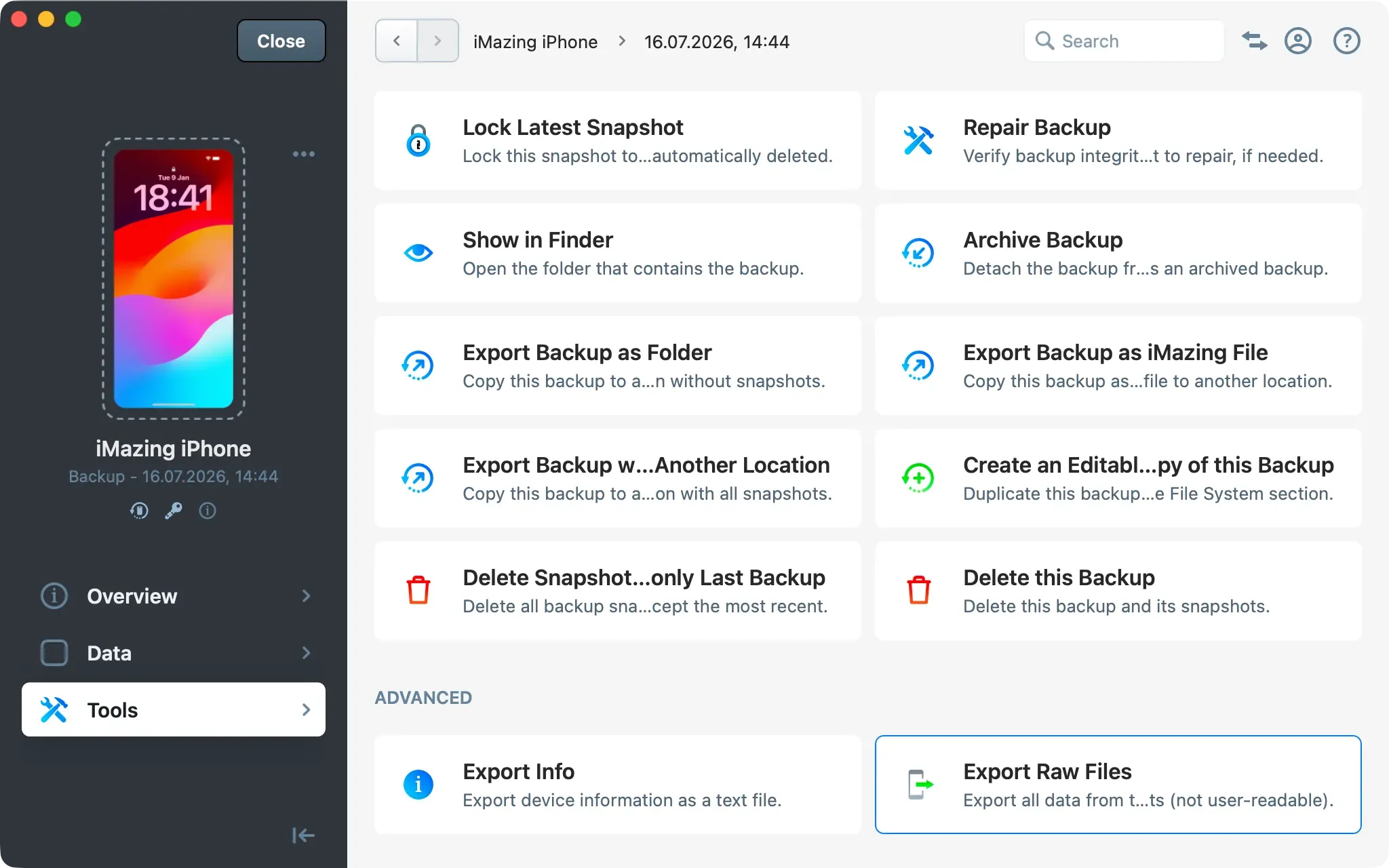
Raw export copies the backup's files and folders as they are stored, including raw SQLite databases, Plist files, media, and app sandboxes. Use it to examine the backup directly, to ingest it into third-party forensic tools, or to reach data that the dataset views do not expose.
- In the open backup, click Tools in the sidebar.
- Under Advanced, click Export Raw Files.
- Choose a destination folder on your Mac or PC.
Export all data at once
Export All Data is a guided wizard that exports multiple datasets in a single operation, each saved into its own folder in a human-readable format. Use it when you want the whole backup delivered as files rather than browsing one dataset at a time.
- Click Export All Data in the Quick Actions of the Overview section, or in Tools under General.
- Select the data types to include.
- Click Export and choose a destination folder on your Mac or PC.
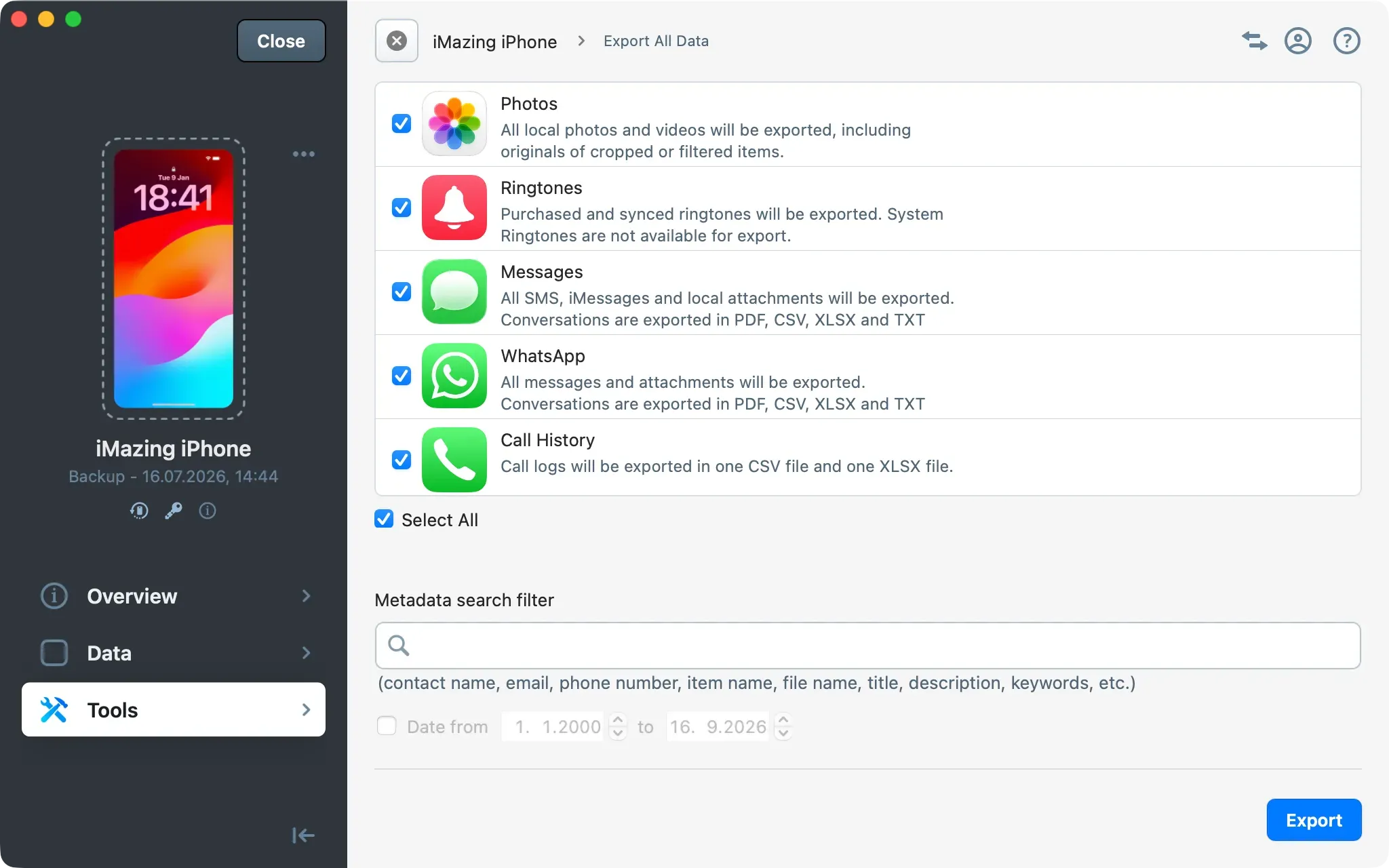
Note: Music, Videos, and Books are not included in an iOS backup, so Export All Data skips them when run from a backup.
Important: Exported data is saved in human-readable, unencrypted formats and cannot be restored to an iOS device.
Export files from the File System
The File System dataset gives you direct access to the files included in the backup, arranged in a browsable folder tree.
- In the Data section, select File System.
- Navigate the folders, or use the Search field to filter by filename or pattern. Wildcards are supported, for example
*.sqliteorcom.apple.*. - Select the files you want, then click Copy to Mac (macOS) or Copy to PC (Windows) in the bottom toolbar.
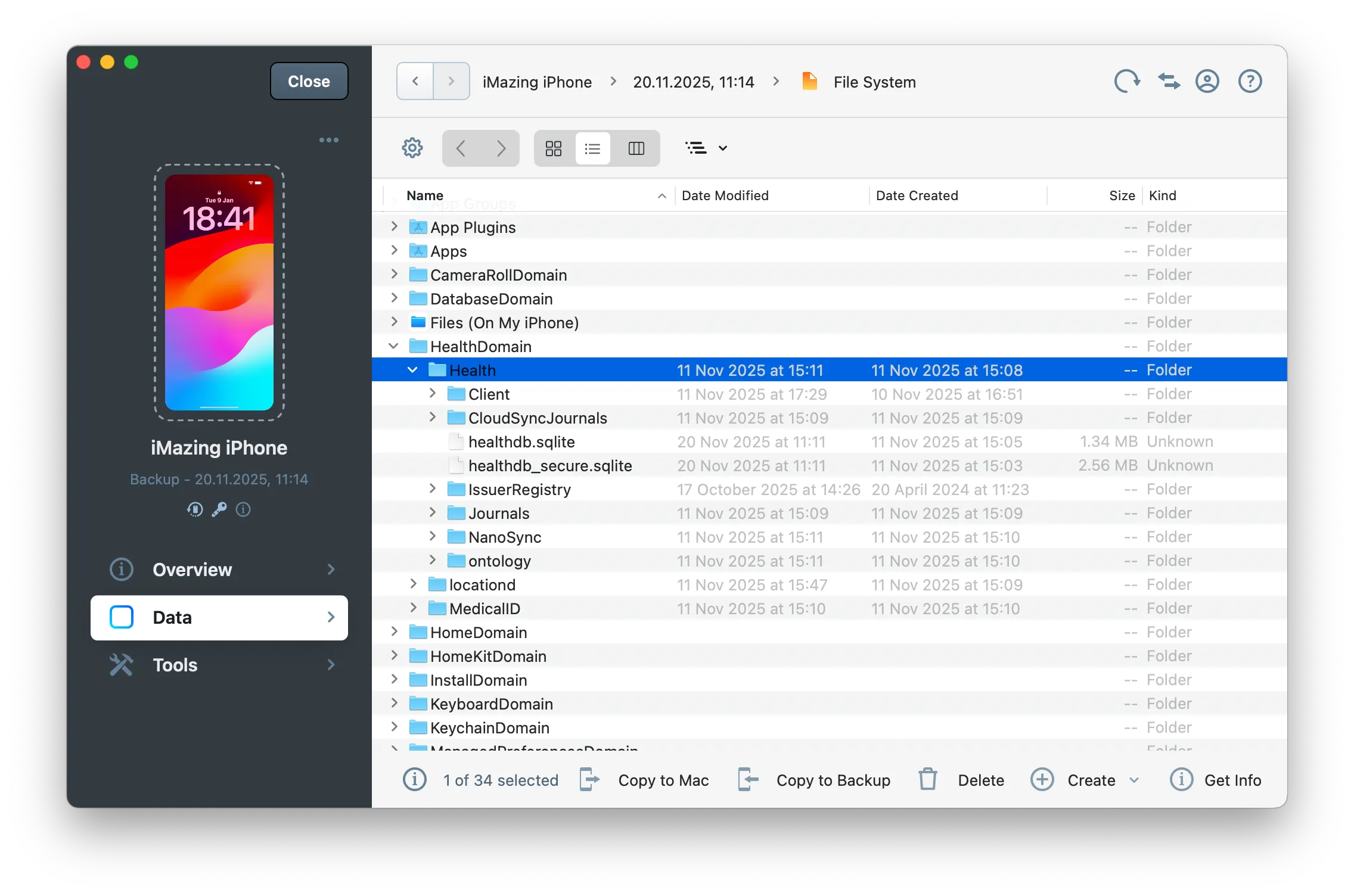
Tip: Third-party app data is available the same way under Data > Apps: select an app to browse the files and data it backed up, then export them with Copy to Mac or Copy to PC. See Export, back up, and transfer iOS apps' data and settings for details.